

When most people hear “dental implants,” they often think of one standard treatment. So when you come to our office for a free implant consultation, you might be surprised at just how many options there are. In reality, there are several types of dental implants, each designed for different needs.
At the Center for Cosmetic Dentistry, our three generations of dentists choose what’s best for your situation from three main choices: traditional dental implants, mini dental implants, or mono dental implants. While all of them are designed to replace missing teeth, they differ in key ways that affect the procedure and cost, among other factors.
This guide breaks down the differences in simple terms so you can make an informed choice about your tooth replacement needs.
Why You Should Know About the Types of Dental Implants
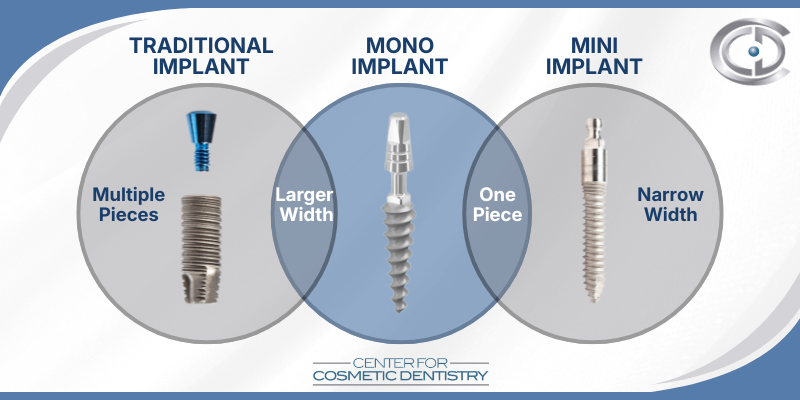
Dental implants are small posts (often made of titanium) that we secure in the jaw to hold replacements for missing teeth. However, implants vary in size and the number of components used in their designs.
The type of dental implant used for your tooth replacement has a major impact on your experience as a patient. The choice affects how invasive the procedure is, whether you need bone grafting, how soon you leave with a final restoration, and how much your treatment costs. Understanding those distinctions up front means you’ll have fewer surprises in the long run. It also means you’ll have more clarity and confidence moving forward with dental implants in general.
Traditional Dental Implant
Traditional dental implants are the option you’re most likely to be familiar with. This option measures at least 3 mm but can reach 6-7 mm in some cases. It features two components: the implant screw and the abutment.
To place a traditional implant, your dentist must make a large incision in the gums before securing the large screw into the jawbone. After several months of healing, they can place an abutment before finally securing a crown, bridge, or denture.
Because of this multi-step process, traditional implants require more time and more surgical involvement than mini or mono implants.
Due to their size, traditional implants also require sufficient healthy jawbone to support them. Patients who have lost bone as a result of tooth loss may need a bone graft in order to be a candidate for conventional implants.
This adds more time and another costly step before you’ll be smiling with a complete set of teeth. Overall, we find that tooth replacement with traditional implants is more expensive than the alternatives.
Because of the limitations of conventional implants, our dentists typically opt for mini or mono implants.
Mini Dental Implant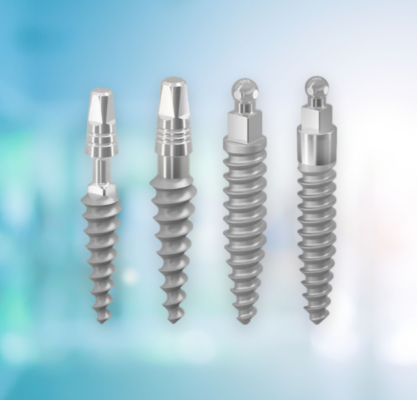
Mini dental implants are smaller than traditional implants. They measure less than 3 mm in diameter and use a simplified one-piece design.
Because of their slim, streamlined shape, mini implants are minimally invasive. Instead of our dentists having to make a large incision, we can place a mini implant by creating a small pilot hole in the gums and securing the post into the jawbone. The process is so gentle on the surrounding tissue that, in many cases, we can place a realistic, functional replacement for your teeth immediately after securing the implant. This means most patients enjoy same-day results with mini implants!
One of the biggest advantages of mini implants is that they can often be placed in patients with reduced bone density. Because of their narrow diameter, there’s a good chance you won’t need to undergo bone grafting to be eligible for placement. This can make mini implants an option for patients who were previously told they did not have enough bone for traditional or mono dental implants.
All in all, this implant’s smaller design and less invasive placement often make it the most affordable option for replacing teeth compared to other types of implants.
Mono Dental Implant
Mono dental implants have some characteristics of both traditional and mini dental implants. They are typically 3 mm or wider, making them closer to a conventional implant size, but they use a one-piece design like mini implants. We might recommend larger mono implants over mini implants if we think you need more support to handle biting and chewing in a specific area of the mouth.
Thanks to their one-piece design and self‑tapping threads, mono implants are also minimally invasive. That means our dentists can place them in a very similar way to mini implants. We simply make a small hole and secure the implant in the bone. After placement, we can usually attach a replacement tooth right away.
Some mono implants also have an integrated bendable collar. This feature allows our dentists to strategically position them in your jawbone, making the most of the bone you do have. This flexibility to avoid bone grafting in many cases, despite the implants’ wider design. However, in patients with a very narrow jawbone, we might recommend the mini dental implant instead.
We find that using mono implants for tooth replacement is more affordable than traditional implants, but it is a slightly larger investment than mini implants. Still, our dentists recommend monos for their unique advantages in many cases.
Comparing the Types of Dental Implants Side-by-Side
Here’s a snapshot of how the three implant options compare:
| Features | Traditional | Mini | Mono |
|---|---|---|---|
| Size (Width) | 3+ mm | Less than 3 mm | 3+ mm |
| Design | Two pieces | One piece | One piece |
| Invasiveness | More invasive | Less invasive | Less invasive |
| Same-Day Results | No | Yes | Yes |
| Cost | $$$ | $ | $$ |
| Bone Grafting Needed | Often | Rarely | Rarely |
While the differences among the three types of dental implants can be tricky to pinpoint, we ultimately make the decision based on your anatomy. When you come in for a free consultation, one of our dentists will take a 3D CBCT scan of your mouth and perform an exam to recommend the best implant option for your needs.
Learn About the Types of Dental Implants at a Free Consultation
The Center for Cosmetic Dentistry offers three types of dental implants: traditional implants, mini implants, and mono implants. Our dentists prefer mini and mono dental implants in most cases because their benefits enable us to support patients with limited bone volume, often at a much lower price point than traditional two-piece systems.
No matter which option best fits your smile, our family of dentists will treat you like one of their own, taking the time to explain what to expect from each option.
Are you ready to explore your options for dental implants? Schedule a free consultation to find the best option for you.
